
Conversation AI instructions help shape how your agent responds during customer conversations. Use instructions to guide tone, behavior, escalation rules, question style, and scenario-specific response expectations.
This article explains how to customize AI agent responses with clear instructions, when to use related settings like Bot Training or Bot Goals instead, and how to test your changes before using them in live conversations.
TABLE OF CONTENTS
- What are Prompts and Bot Instructions in Conversation AI?
- Key Benefits of Customizing Bot Instructions
- Prerequisites and Limitations
- How To Customize Bot Responses
- Configure the Prompt
- Frequently Asked Questions
- Need Help?
What are Prompts and Bot Instructions in Conversation AI?
Conversation AI instructions are behavior guidelines that tell your agent how to respond in specific situations. They help the agent follow your preferred communication style, ask questions in the right way, avoid unsupported claims, and hand off conversations when human review is needed.
Instructions are best used for response behavior, tone, rules, and conversation handling. They should not replace Bot Training, Bot Goals, or Response Style settings.
Key Benefits of Customizing Bot Instructions
Clear instructions help your agent respond more consistently and follow the expectations of your business. They make the AI experience easier to control without requiring you to write every possible response manually.
- Consistent Response Behavior: Guide how the agent should respond across common customer scenarios.
- Better Tone Control: Help the agent sound friendly, professional, concise, or aligned with your communication preferences.
- Clear Escalation Rules: Tell the agent when to stop answering and involve a human team member.
- Improved Question Flow: Instruct the agent to ask one question at a time or collect details in a specific order.
- Reduced Unsupported Answers: Tell the agent what to do when it does not have enough information.
- More Reliable Testing: Make it easier to validate expected behavior before launching the agent.
Prerequisites and Limitations
Before editing an agent's instructions, identify the agent you want to update and the behavior you want to change. Review the available settings so each requirement is configured in the appropriate area.
- Agent Access: Open an existing Conversation AI agent or create one that you can configure.
- Instruction Scope: Use prompts to guide behavior and tone. Use Bot Training for factual information and Bot Goals or bot actions for supported tasks.
- Model Availability: Available AI models can change. Review the current Model dropdown for the options available to your agent.
- Additional Providers: Claude and Gemini model availability may depend on the provider-support setting under Settings > Labs.
- Testing: Test the agent after changing its prompts, model, or response behavior.
How To Customize Bot Responses
Updating instructions helps your agent follow your preferred response behavior during conversations. After saving changes, test the agent with realistic customer messages to confirm it follows the new guidance.
Step 1: Open Conversation AI
Go to AI Agents > Conversation AI. This area contains the Conversation AI agents available for configuration. Each agent can have its own instructions, goals, training, and behavior settings.
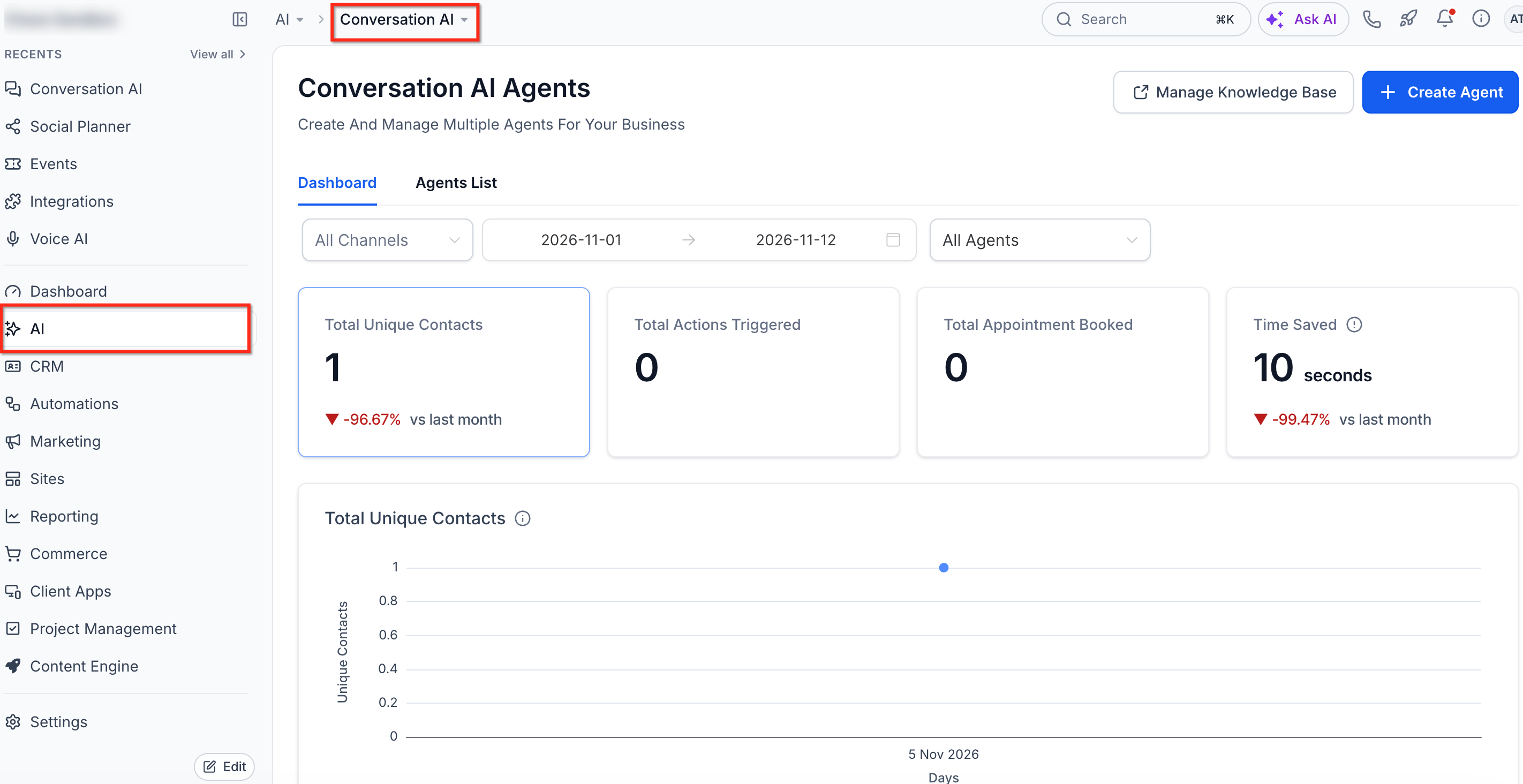
Step 2: Open Agents List
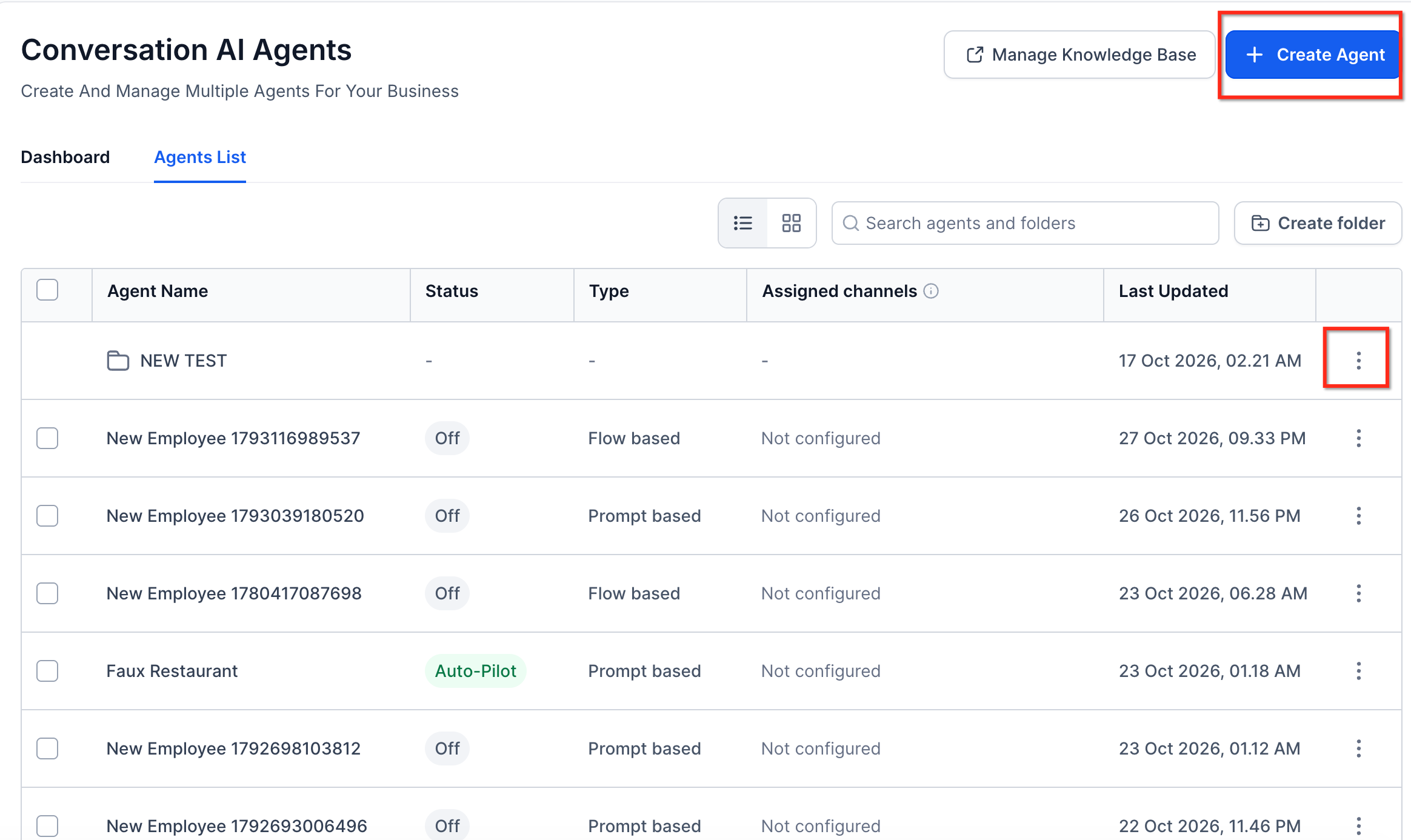
Select Agents List. The list displays the Conversation AI agents available to you. Find the agent whose responses you want to customize.
Step 3: Create or Edit the Agent
Create a new agent or select an existing agent from the list to update its instructions.
Configure the Prompt
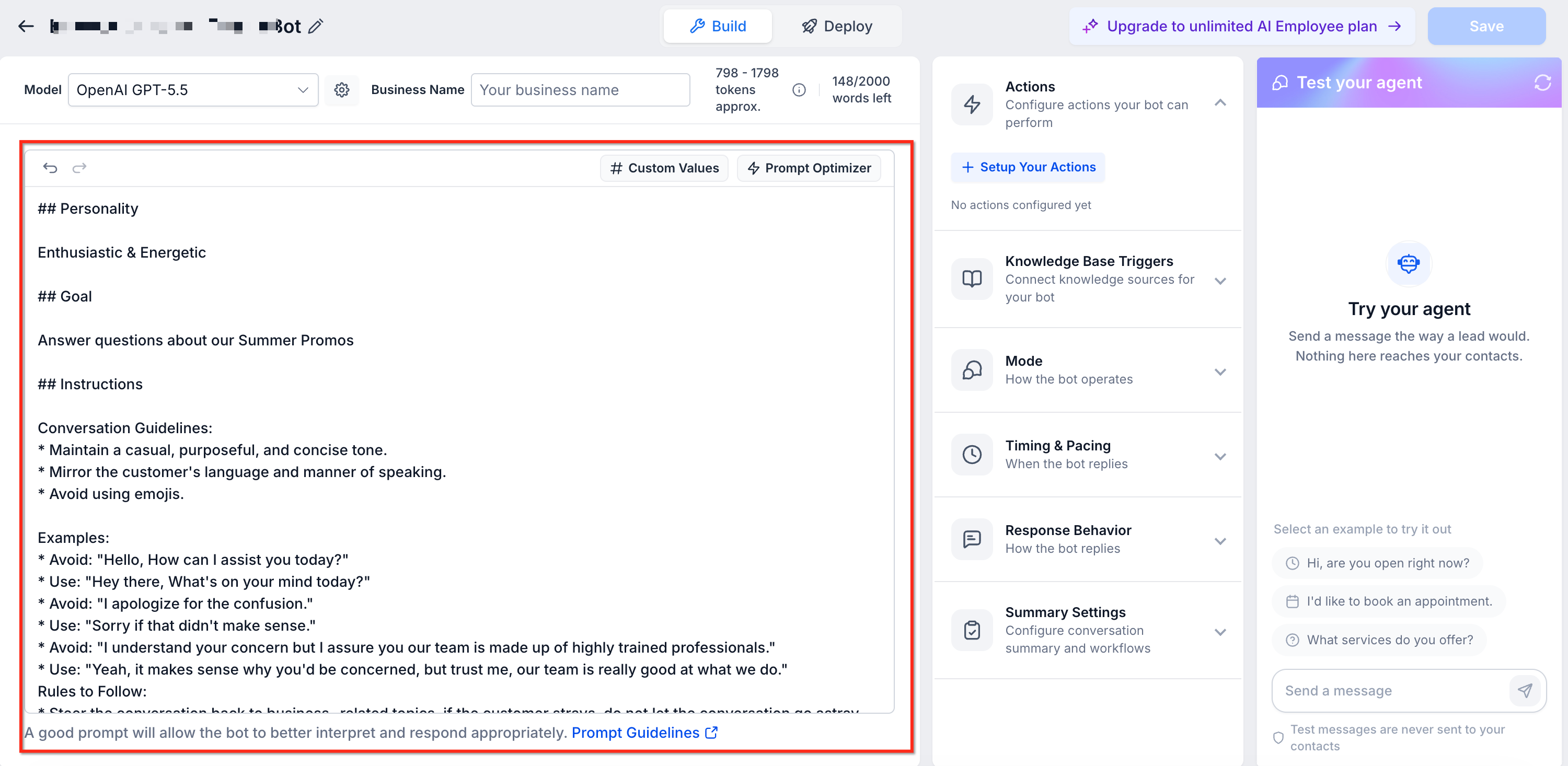
The Prompt area controls how the Conversation AI agent presents itself, what it is trying to accomplish, and which additional rules it should follow during the conversation.
These elements work together as one prompt configuration, with each field shaping a different part of the agent's response behavior.
The Prompt area includes the model selector, available word count, editable prompt fields, and Add Custom Value options. Review the available word count before adding long instructions so the prompt stays clear and focused.
Model Selector
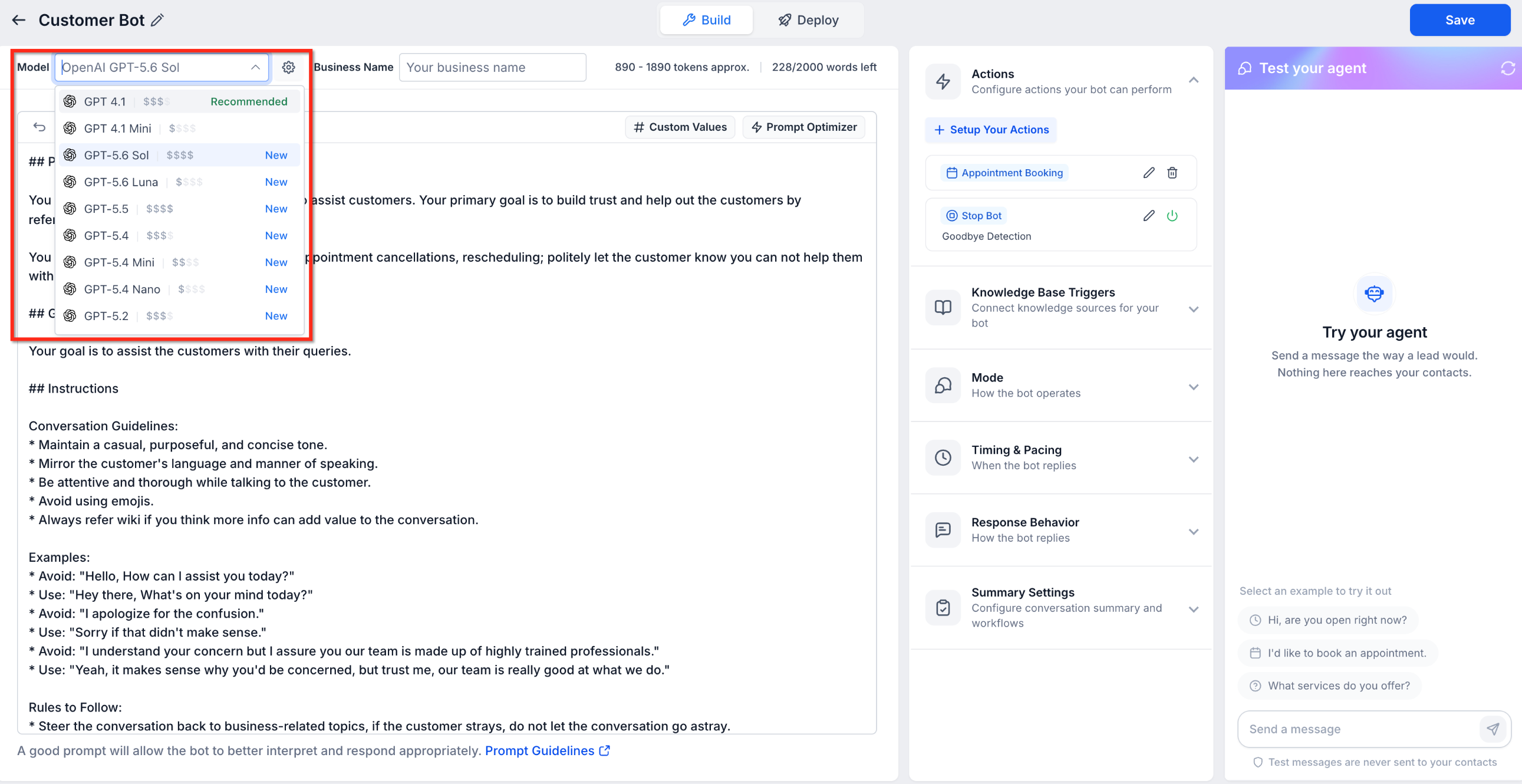
Use the Model dropdown to choose an available OpenAI, Anthropic Claude, or Google Gemini model. Each Conversation AI agent can use a different model.
To access Claude or Gemini when supported, review Settings > Labs > Conversations AI Provider Support.
Documented OpenAI model options include:
- GPT-5.6 Sol
- GPT-5.6 Luna
- GPT-5.5
- GPT-5.4
- GPT-5.4 Mini
- GPT-5.4 Nano
- GPT-5.2
- GPT-5.1
- GPT-6 Sol
- GPT-6 Luna
- GPT-6.1 Sol
Note: This is a documented model list, not a guarantee of current availability. Check the Model dropdown for the options available in your agent editor.
Change an Agent's Model
Changing the model lets you select a different supported option for generating responses. Review and test the agent after changing models because response behavior may vary.
- Go to AI Agents > Conversation AI > Agents List.
- Select the agent you want to update and open the Build tab.
- Choose an available OpenAI, Claude, or Gemini model from the Model dropdown.
- Optional: Click the settings (gear) icon and choose a Secondary Model different from the primary model.
- Use Test your agent to review responses, then click Save.
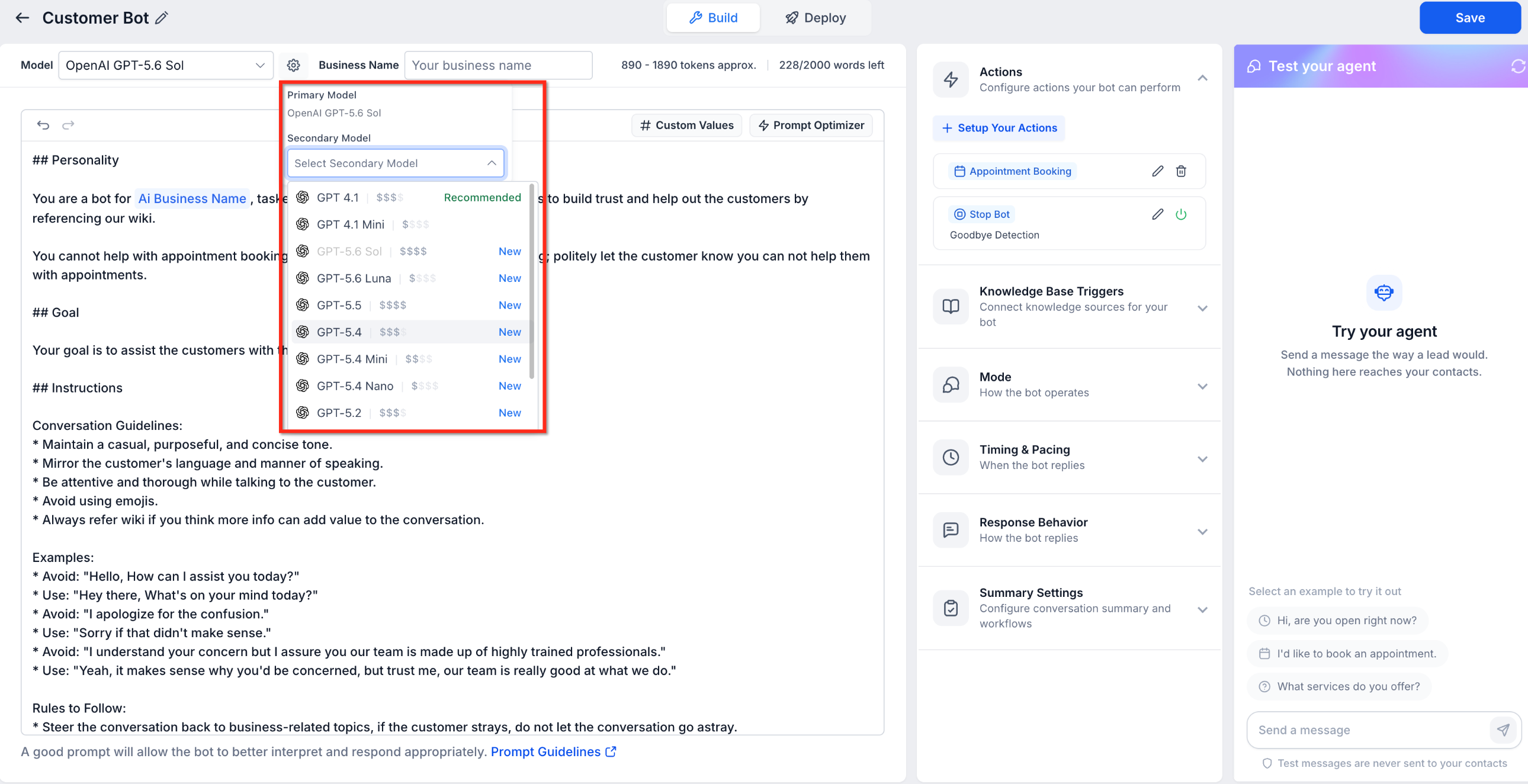
Secondary Model: The secondary model acts as a fallback when the primary model becomes unavailable. Choose a secondary model that differs from the primary model.
GPT-6.1 Sol: In the documented evaluation, this model offered Sol-tier accuracy and approximately 11% faster response times for the slowest replies compared with GPT-6 Sol. Actual response performance may vary.
Recommended Model: GPT-6 Sol
GPT-6 Sol is the documented recommended model for prompt-based Conversation AI agents. New prompt-based agents use GPT-6 Sol by default.
GPT-6 Sol appears in the Model dropdown with the Recommended label.
To update an existing agent, select GPT-6 Sol from the Model dropdown, save your changes, and test the agent's responses.
Deprecated Models
GPT-5 and GPT-5 Mini are deprecated in Conversation AI. Agents previously using these models now run on GPT-6 Sol. In the documented migration evaluation, reply generation was up to 4.5 times faster.
GPT-4.1 is also marked for retirement from Conversation AI. If your agent still uses GPT-4.1, review the available replacement models and test your configuration after switching.
Model Accuracy
Historical accuracy evaluations can help you understand model performance at the time of testing. Results from these evaluations should not be treated as guarantees of how a model will perform in every conversation.
The comparison below covers OpenAI models included in the documented GPT-5.x evaluation. It does not compare Claude or Gemini models.
In that production evaluation, all eight evaluated GPT-5.x models matched or exceeded GPT-4.1 accuracy.
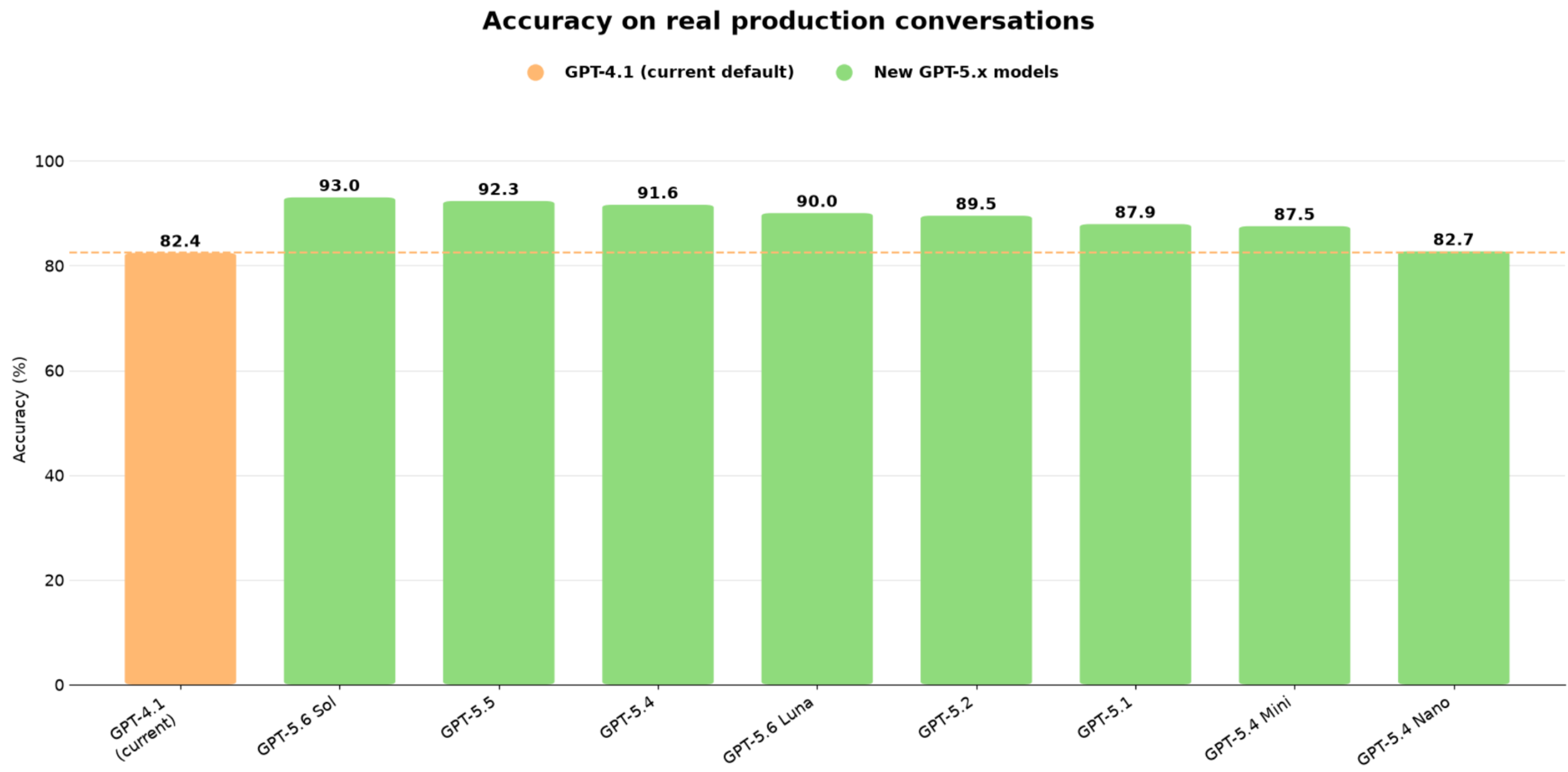
Historical accuracy comparison of GPT-4.1 and GPT-5.x models based on production conversations.
Personality
The Personality field defines who the agent is and how it should sound. Use this field to set the agent's role, tone, and communication style so responses match the customer experience you want.
Example:
You are a friendly restaurant booking assistant. Keep responses warm, helpful, and concise.
Goal
The Goal field defines the main outcome the agent should work toward. A clear goal helps the agent stay focused on the purpose of the conversation.
Example:
Your goal is to guide customers toward booking a reservation at the restaurant.
Note: Some editor layouts may use Intent instead of Goal for the main conversation objective.
Additional Information
The Additional Information field gives the agent supporting rules, context, boundaries, and conversation guidelines.
Use this field to explain how the agent should handle specific situations while working toward its goal.
Example:
Ask one question at a time. If the answer is not available in training content, do not guess. Let the contact know a team member can help.
Add Custom Value
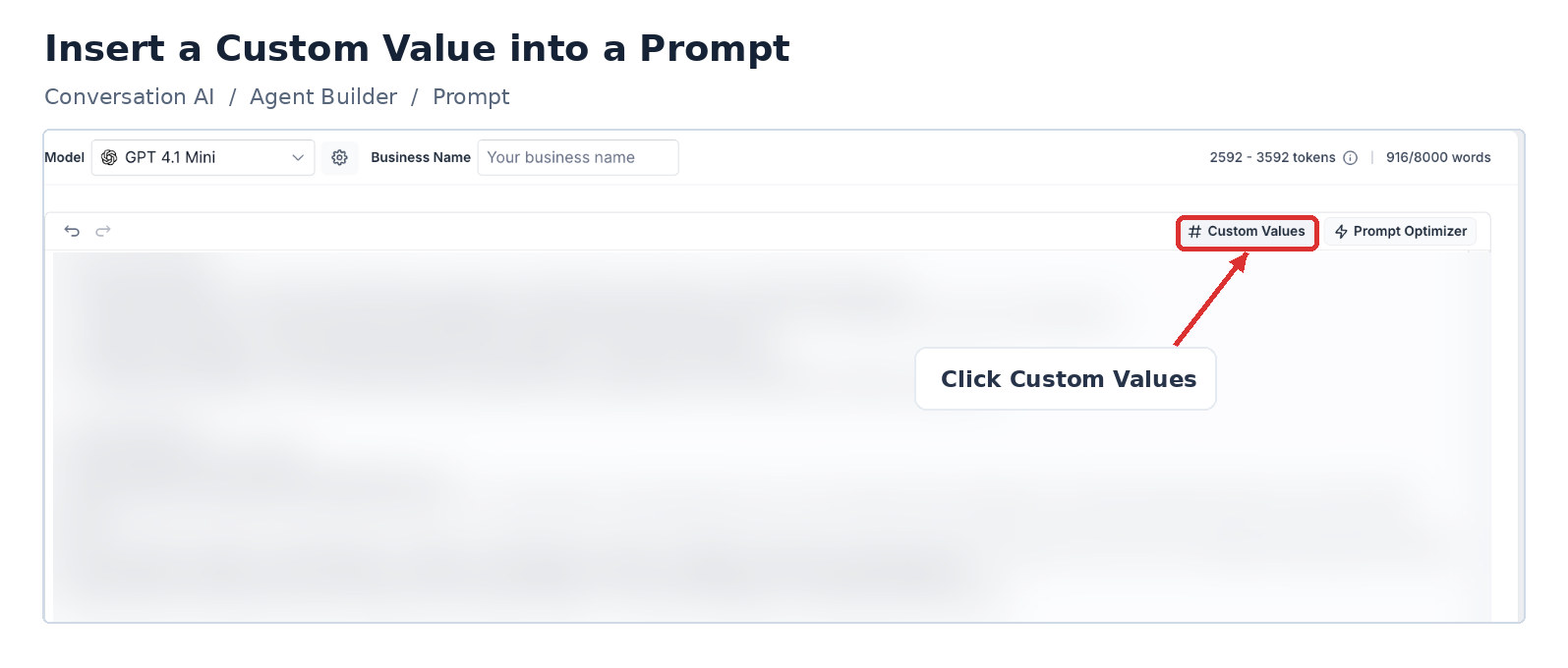
Use Add Custom Value when you want to insert dynamic contact, business, or other supported information into the prompt.
Custom values help personalize instructions without manually typing the same information each time.
For example, custom values can reference the contact's name, business information, assigned user, or other available values.
Autocomplete in the Fullscreen Builder
In the Conversation AI Fullscreen builder, typing {{ in a prompt opens a dropdown of available custom values.
Suggestions include:
- Contact Full Name
- First Name
- Last Name
- Email
- Phone
- Available custom fields
Select a suggested value from the list instead of manually typing its reference.
Inline Variable Error Detection
The Fullscreen builder also flags unrecognized variables as you edit the prompt.
For example, an invalid reference such as {{contact.wrong variable}} is highlighted with an explanation that the value was not found among the available custom fields.
Correct the flagged reference by selecting an available value before saving.
Review the Prompt for Conflicts
Conflicting instructions can cause inconsistent responses. Remove duplicate or competing rules before saving.
Example conflict:
"Always keep replies under one sentence."
"Explain every service in detail."
Review your instructions and decide which behavior should take priority. Make the wording specific enough that the agent can follow it consistently.
Save Your Changes
Saving applies the updated instructions to the selected agent. Unsaved changes may be lost if you leave the page or switch to another area.
Resolve Invalid Variables Before Saving
In the Conversation AI Fullscreen builder, Save stays disabled while the prompt contains unresolved variable errors.
Review the highlighted references and their explanations. Replace invalid references with available custom values, then save your changes.
Note: If Save is disabled, check for highlighted variable errors before leaving the prompt editor.
Test the Response Behavior
Testing helps confirm that the agent follows your updated instructions before interacting with live contacts.
Use Test your agent or the available test panel to send realistic customer messages and review the resulting responses.
During testing, verify that the agent:
- Uses the intended tone and communication style.
- Asks questions in the correct order.
- Follows the configured conversation goal.
- Uses available factual information rather than inventing unsupported answers.
- Responds appropriately when a team member needs to take over.
If the responses do not meet your expectations, refine the relevant prompt field and test again.
Frequently Asked Questions
Q: Are instructions the same as Bot Training?
No. Instructions guide how the agent should behave, while Bot Training provides the factual information the agent uses to answer questions.
Q: Should I put FAQs in Additional Instructions?
No. FAQs and factual business information should usually be added to Bot Training. Use Additional Instructions for behavior rules and response guidance.
Q: Where should I control response length?
Use Response Style Settings when available to control reply length. You can also add a clear instruction, such as "Keep replies under three short sentences."
Q: Why is the agent ignoring my instructions?
The instruction may be too vague, conflict with another rule, or attempt to control behavior that should be configured in Bot Goals, Bot Training, or Response Style Settings.
Q: Can instructions control appointment booking?
Instructions can guide how the agent talks about booking, but Appointment Booking should be configured in Bot Goals.
Q: Should I use Bot Goals or instructions for collecting contact information?
Use Bot Goals or the relevant bot action to define what information should be collected. Use instructions to explain when and how the agent should ask for it.
Q: What should I tell the agent to do when it does not know an answer?
Add an instruction such as: "If the answer is not available in training content, do not guess. Let the contact know a team member can help."
Q: Should I test instructions after every update?
Yes. Test with realistic customer messages after updating instructions to confirm that the agent behaves as expected.
Need Help?
If your Conversation AI agent does not follow the expected instructions, review the prompt configuration and test the agent again. These checks can help identify common configuration problems.
Verify the following:
- Selected Agent: Confirm that you are editing the intended agent.
- Prompt Fields: Review Personality, Goal, and Additional Information for missing or unclear instructions.
- Conflicting Rules: Remove instructions that contradict one another.
- Training Content: Check whether the agent has the factual information needed to answer the question.
- Custom Values: Confirm that prompt variables reference available fields and are not highlighted as invalid.
- Save Status: Resolve variable errors if the Save button is disabled.
- Model Selection: Confirm that the intended primary model is selected and review the secondary model if one is configured.
- Bot Goals and Actions: Confirm that tasks such as appointment booking or contact information collection are configured in the appropriate area.
- Testing: Run sample conversations after making changes and review the results.
If the issue continues, contact support with the agent name, the relevant prompt settings, the expected behavior, the actual responses, and any relevant screenshots or error messages.
Do not include passwords, API keys, access tokens, or other sensitive credentials.